
BURGUNDY
Burgundy is among the world’s greatest wine regions known for its silky, elegant, complex Pinot noirs and structured dry whites from Chardonnay.
It only has about 29,000 ha (71500 acres) under vines, having an output of nearly 17 million cases.
Grape Varieties
The two most famous and widely grown varieties famous all over the world are Chardonnay and Pinot noir.
Other minor grape varieties include : Gamay, Aligoté, César, Pinot Gris, Pinot Blanc, Sacy, Melon (Muscadet), Tressot, Sauvignon Blanc and Sauvignon Gris. Although each appellation has only a few grapes on their approved list.
Chardonnay
- The most widely planted variety in Bourgogne, with almost 48% land under Chardonnay vines. Chardonnay is a cross of Pinot Noir and Gouais Blanc.
- The wines of the Côte Chalonnaise and the Mâconnais are medium to full bodied, fruit forward and easy to drink.
- Chablis produces more citrusy, floral wines with mouth-puckering acidity and distinguished ‘flinty’ minerality.
- Côte de Beaune has a style rich in notes of white peach, ripe pear, apple, citrus, and honeysuckle.
- They develop notes of toasty nuts, honey and vanilla from oak aging and can improve in complexity for decades.
- The second most widely grown grape in this region is Pinot Noir occupying around 35% of the vineyards in Bourgogne. It is a variety which is native to Bourgogne.
- Pinot noir is also grown in all regions except Chablis. It is a dominating variety in the Côte d’Or region, especially Côte de Nuits.
- Pinot noir produces wines with ruby color which turns to garnet or brick red with age.
- Wines range from medium- to full-body with soft and delicate tannins dominated by the flavors of fresh berries, cherry, cinnamon, and pepper. It may develop vegetal and meaty notes with maturity.
Aligoté
- This white-wine variety hardly occupies around 5% of the vineyards in Bourgogne. It is a cross between Pinot Noir and Gouais Blanc. Aligoté can produce both AOC Régionale Bourgogne Aligoté and AOC Village Bouzeron wines.
- Bourgogne Aligoté is typically consumed young and it has pale yellow in color with juicy acidity and notes of white peach, lemon, green apple.
Traditional Kir – Bourgogne Aligoté (120ml) + Crème de Cassis (30ml)
Gamay
- Gamay occupies around 10% of the vineyards in Bourgogne and is the main variety used in the red Mâcon wines and in the blend for Crémant de Bourgogne.
- Gamay produces wines with ruby or garnet color which are lively and fruity, with light tannins and red berry and cherry notes.
Geography
It is located in eastern central France, to the east of Loire Valley, southwest of Alsace and south of Champagne.
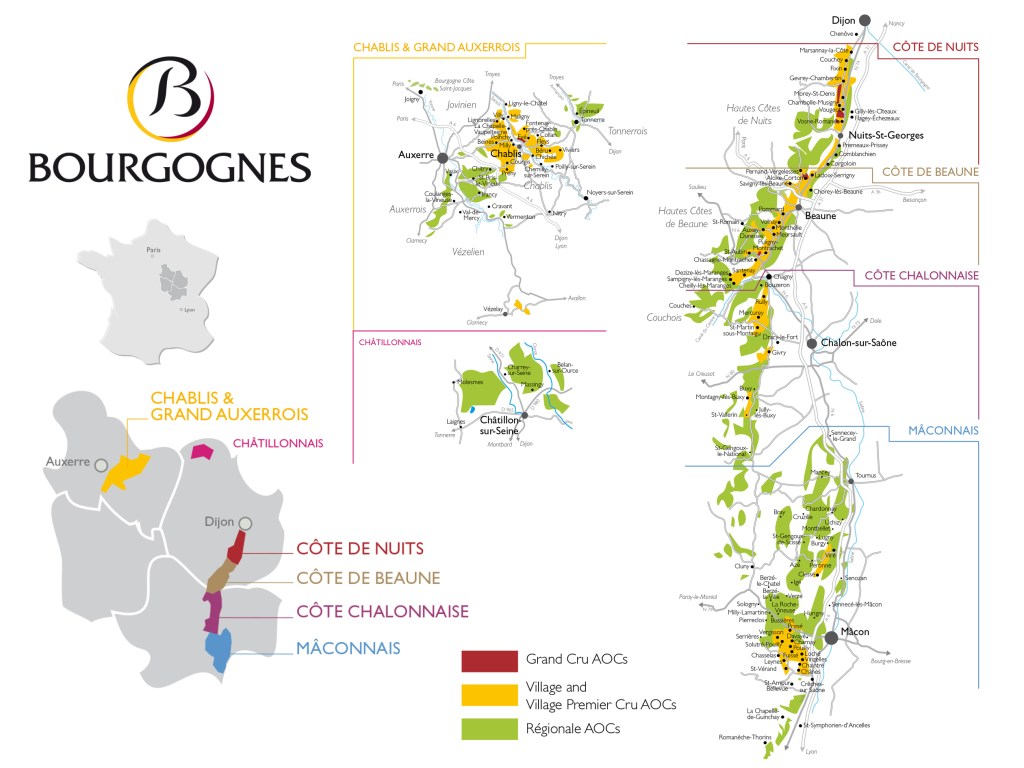
The wine-producing areas of Burgundy are divided into the four distinct vineyard areas –
- Chablis and the Grand Auxerrois
- Côte d’Or (Côte de Nuits and Côte de Beaune)
- The Côte Chalonnaise and Couchois
- The Macônnais
Appellations of Burgundy
You may come across 100 Appellations d’Origine Contrôlée (AOCs). However, there are only 84 AOCs. The rest are made up by the Dénominations Géographiques Complémentaires (DGCs) within the Bourgogne AOC.
The 84 AOCs are divided into –
7 Regional AOCs
44 Village AOCs
33 Grand Cru AOCs
Chablis and the Grand Auxerrois
Chablis is about 80 miles (129 km) north-west of Côte d’Or and is actually closer to the Aube district of Champagne than it is to Burgundy. The weather in Chablis has cold winters and cool summers, which makes it difficult to fully ripen grapes. Chablis’s vineyards are located on and around the south-facing slopes of Kimmeridgian marl, which provides better sun, protection from northerly winds, and an excellent base of mineral nutrients.
It covers about 6500 hectares of land and has 1 Grand cru producing Chardonnay wines.
AOCs of Chablis
- Petit Chablis – The vineyards of the Petit Chablis appellation are situated between and around some of the more prestigious vineyards, occupying those areas where the soils and sun exposure are less desirable when compared to grand cru or premier cru. Clay-limestone soil is found in these vineyards.
- Chablis (Chablis Premier Cru) – There are 40 premier cru vineyards within the Chablis AOC region and are generally grouped in 17 principal premiers crus. The best known of these include Fourchaume, Montée de Tonnerre, Vaillons, Mont de Milieu, Montmains, Les Forets and Vosgros. The Portlandian soil could be found in these vineyards.
- Chablis Grand Cru – The world famous Chablis Grand Cru vineyards are situated on Kimmeridgian Marl and are divided into seven parcels whose names normally appear on the wine’s label. They are, from largest to smallest: Les Clos(28ha), Vaudésir(15ha), Bougros(15ha), Blanchot(13ha), Les Preuses(11ha), Valmur(11ha), and Grenouilles(9ha). Also it has the 8th parcel named ‘La Moutonne'(2.35ha) which is mostly in the Vaudésir and little in Les Preuses.
Grand Auxerrois
Village Appellations:
- Irancy – only reds using Pinot noir. A little of Cesar is also planted, although maximum 10% can be blended with Pinot noir.
- Saint-Bris – Sauvignon blanc and Sauvignon gris only.
- Vézelay – whites from Chardonnay only.
Regional Appellations
- Bourgogne Chitry
- Bourgogne Côte Saint-Jacques
- Bourgogne Côtes d’Auxerre
- Bourgogne Coulanges-la-Vineuse
- Bourgogne Epineuil – Pinot noir only (mainly red and little rose)
- Bourgogne Tonnerre – only Chardonnay allowed.
The Côte d’Or (the Golden Slope)
It lies southwest of the city of Dijon along a narrow limestone ridge that parallels the west bank of the Saône River. Hills surrounding the region to the north and west provide shelter from the chilly influence of the Atlantic which creates a continental climate of hot summers and cold winters.
Biggest concern here is the summer hail storms which can severely destroy the emerging buds.
The Côte d’Or is divided into Côte de Nuits and Côte de Beaune.
The Côte de Nuits (the night slope)
It takes its name from the town of Nuits-St.-Georges. About 3700 hectares of land under vines stretched for 20km in length with a narrow width of 1km. It has sloping plots of 200-500 m altitude divided into two further sub-regions known as Côte de Nuits and Haute Côte de Nuits.
90% of the wines are red and it is home to 24 Grand Crus, 23 of which produces red wines and 1 produces both Red and White. (Musigny produces red and white)
Only Pinot noir is permitted for red wines and Chardonnay for white wines.
Village AOCs and Grand Crus of Côte de Nuits
- Chambolle-Musigny.
- Musigny. (produces both red and white wines)
- Bonnes-Mares. (shared with Morey-Saint-Denis, however majority of the area is in Chambolle-Musigny)
- Côte de Nuits-Villages.
- Fixin.
- Gevrey-Chambertin.
- Chambertin.
- Chambertin-Clos de Bèze.
- Chapelle-Chambertin.
- Charmes-Chambertin.
- Griotte-Chambertin.
- Latricières-Chambertin.
- Mazis-Chambertin.
- Mazoyères-Chambertin.
- Ruchottes Chambertin.
- Marsannay.
- Marsannay Rosé.
- Morey-Saint-Denis.
- Clos de La Roche.
- Clos de Tart.
- Clos des Lambrays.
- Clos Saint-Denis.
- Bonnes-Mares.
- Nuits-Saint-Georges.
- Vosne-Romanée.
- Echezeaux.
- Grande Rue (La).
- Grands Echezeaux.
- Richebourg.
- Romanée (La).
- Romanée-Conti.
- Romanée-Saint-Vivant.
- Tâche (La)
- Vougeot
- Clos de Vougeot.
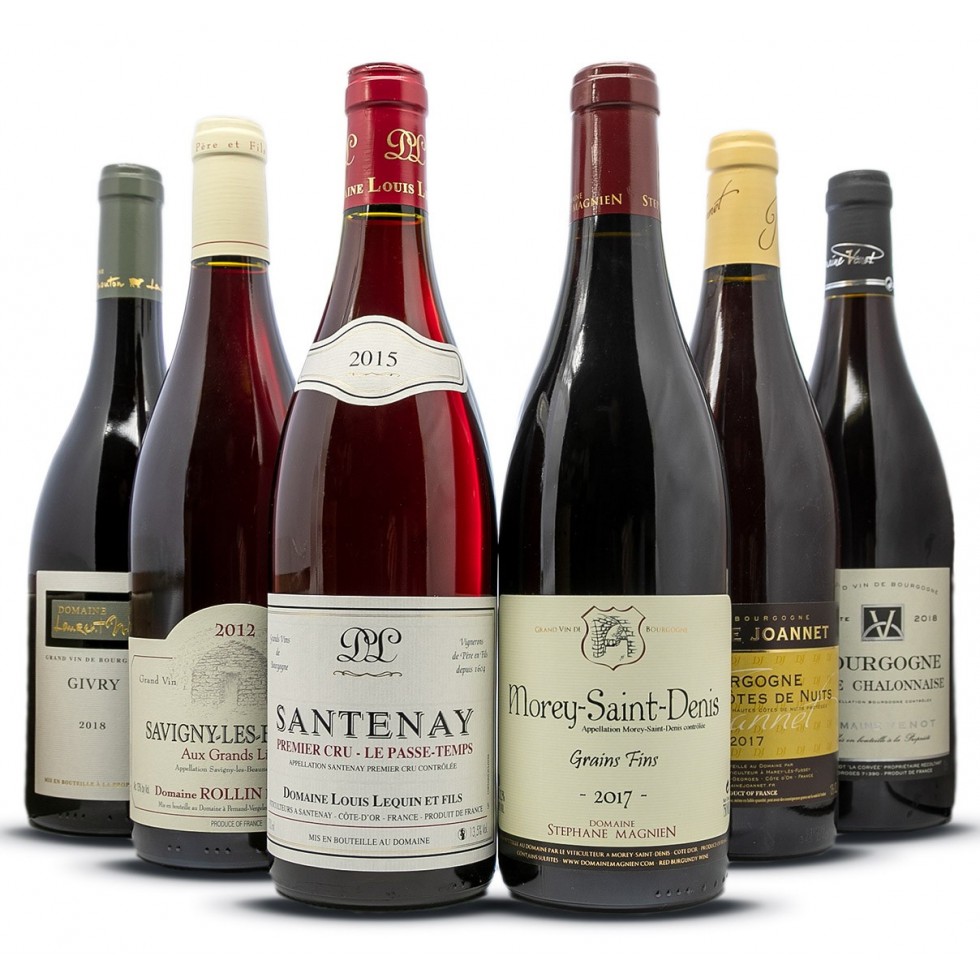
The Côte de Beaune (the slope of Beaune)
It takes its name from the town of Beaune, the commercial heart of Burgundy’s wine trade. It covers about 5900 hectares of land under vines spread across a stretch of 30 km length and 2 km width. The slopes have an elevation from 200-500 m and further divided into two sub-regions of Côte de Beaune and Haute Côte de Beaune.
It houses 8 Grand crus of which 7 exclusively produce whites from Chardonnay and 1 grand cru (Corton) produces both red and white from Pinot noir and Chardonnay respectively.
Village AOCs and Grand Crus of Côte de Beaune.
- Aloxe-Corton.
- Corton. (produces both red and white wines)
- Corton-Charlemagne.
- Charlemagne.
- Auxey-Duresses.
- Beaune.
- Blagny.
- Chassagne-Montrachet.
- Montrachet.
- Bâtard-Montrachet.
- Criots-Bâtard-Montrachet.
- Chorey-Lès-Beaune.
- Côte de Beaune.
- Côte de Beaune-Villages.
- Ladoix.
- Corton.
- Corton-Charlemagne.
- Maranges.
- Meursault.
- Monthélie.
- Pernand-Vergelesses.
- Corton.
- Corton-Charlemagne.
- Charlemagne.
- Pommard.
- Puligny-Montrachet.
- Montrachet.
- Chevalier-Montrachet.
- Bâtard-Montrachet.
- Bienvenues-Bâtard-Montrachet.
- Saint Aubin.
- Saint-Romain.
- Santenay.
- Savigny-Lès-Beaune.
- Volnay.
Côte Chalonnaise (the slope of Chalon)
About 4400 hectares stretched for 25km in length and 7km in width.
Village AOCs of Côte Chalonnaise
- Bouzeron – 100% made from Aligoté grape variety. It has flinty mineral notes, a meaty mouthfeel, good structure, and great vivacity.
- Givry – mainly red wines
- Mercurey – mainly red wines
- Montagny – only white wines
- Rully – white and red wines
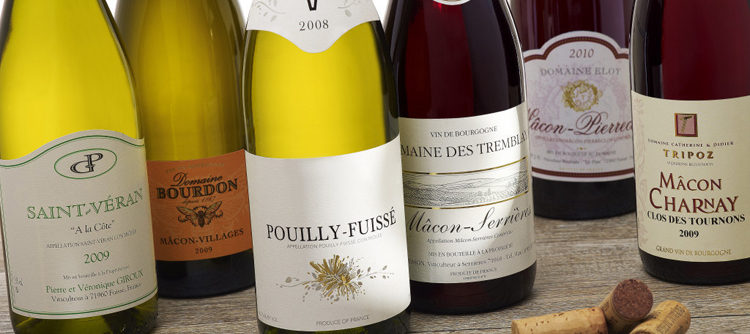
Mâconnais (the region of Mâcon)
About 6500 hectares stretched for 35km in length and 10km in width.
Village AOCs of Mâconnais – only Chardonnay allowed
- Pouilly-Fuissé.
- Pouilly-Loché.
- Pouilly-Vinzelles.
- Saint-Véran.
- Viré-Clessé.
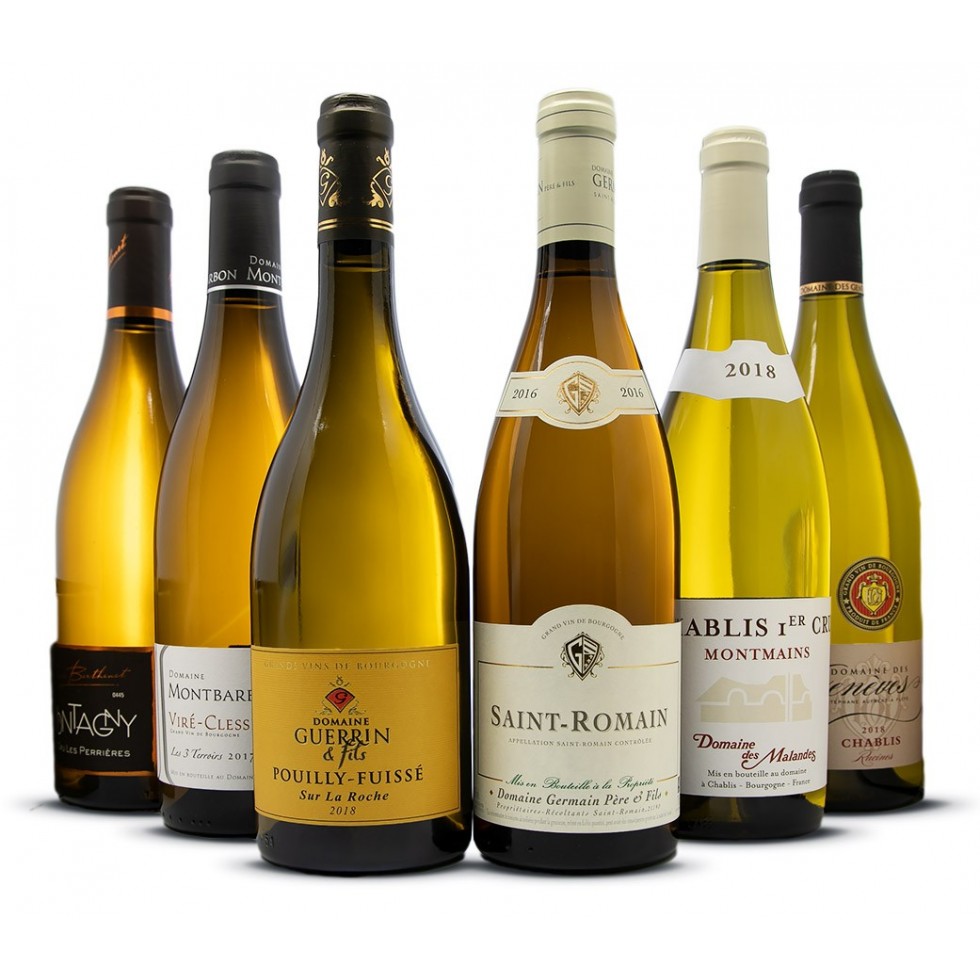
Regional AOCs of Mâconnais
- Mâcon-Villages – only Chardonnay allowed
- Mâcon – mainly red from Pinot noir, Gamay and little white from Chardonnay.
- Mâcon + Village Names – mainly white from Chardonnay and little red from Gamay.
- Mâcon-Azé
- Mâcon-Bray
- Mâcon-Burgy
- Mâcon-Bussières
- Mâcon-Chaintre
- Mâcon-Chardonnay
- Mâcon-Charnay-Lès-Mâcon
- Mâcon-Cruzille
- Mâcon-Davayé
- Mâcon-Fuissé
- Mâcon-Igé
- Mâcon-La Roche-Vineuse
- Mâcon-Loché
- Mâcon-Lugny
- Mâcon-Mancey
- Mâcon-Milly-Lamartine
- Mâcon-Montbellet
- Mâcon-Peronne
- Mâcon-Pierreclos
- Mâcon-Prissé
- Mâcon-Saint-Gengoux-Le-National
- Mâcon-Serrières
- Mâcon-Solutré-Pouilly
- Mâcon-Uchizy
- Mâcon-Vergisson
- Mâcon-Verzé
- Mâcon-Vinzelles
Côte Chalonnaise and Mâconnais share the same general characteristics of the Côte d’Or, but the winter temperatures are moderated due to its closeness to the Mediterranean.
Regional Appellations
- Bourgogne
- Bourgogne Chitry
- Bourgogne Côte Chalonnaise
- Bourgogne Côte d’Or
- Bourgogne Côte Saint-Jacques
- Bourgogne Côtes d’Auxerre
- Bourgogne Côtes du Couchois
- Bourgogne Coulanges-La-Vineuse
- Bourgogne Épineuil
- Bourgogne Hautes Côtes de Beaune
- Bourgogne Hautes Côtes de Nuits
- Bourgogne La Chapelle Notre-Dame
- Bourgogne Le Chapitre
- Bourgogne Montrecul
- Bourgogne Tonnerre
- Bourgogne Aligoté – for wines made from the Aligoté grape variety only.
- Bourgogne Mousseux – for sparkling red wine from Bourgogne.
- Bourgogne Passe-tout-grains – for wines made from ⅔ Gamay maximum + ⅓ Pinot noir minimum.
- Côteaux Bourguignons / Bourgogne Grand Ordinaire / Bourgogne Ordinaire – generic appellation for red, white and rosé wines made in Bourgogne.
- Crémant de Bourgogne – white and rosé sparkling wines made by the Traditional Method
- Mâcon / Mâcon-Villages / Mâcon + the name of the village
 The Wine Geek
Very informative and interesting stuff !
LikeLiked by 1 person