
Champagne – The world’s most favorite sparkling wine.
The word Champagne was used to refer to sparkling wines from all over the world, but now the name is legally controlled and its use is restricted only to the sparkling wines made in the region which is surprisingly of the same name – Champagne.
Location
The Champagne region lies at 49°N latitude
It is one of the most northern vineyard-growing areas of the world.
It has a cool climate, with growing season rarely warm enough to ripen grapes to the levels required for standard winemaking. This climate provides Champagne with its hallmark acidity.
Region
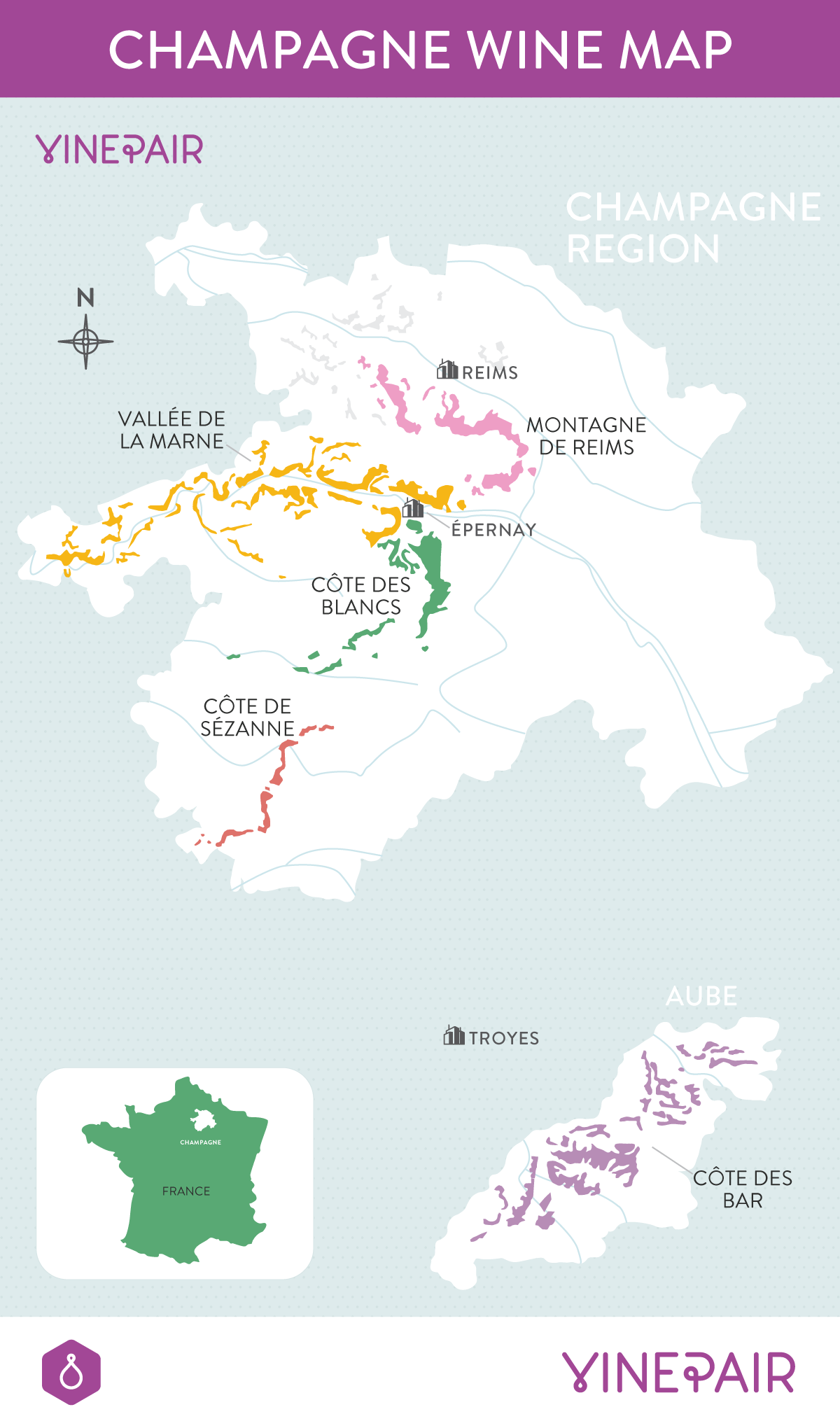
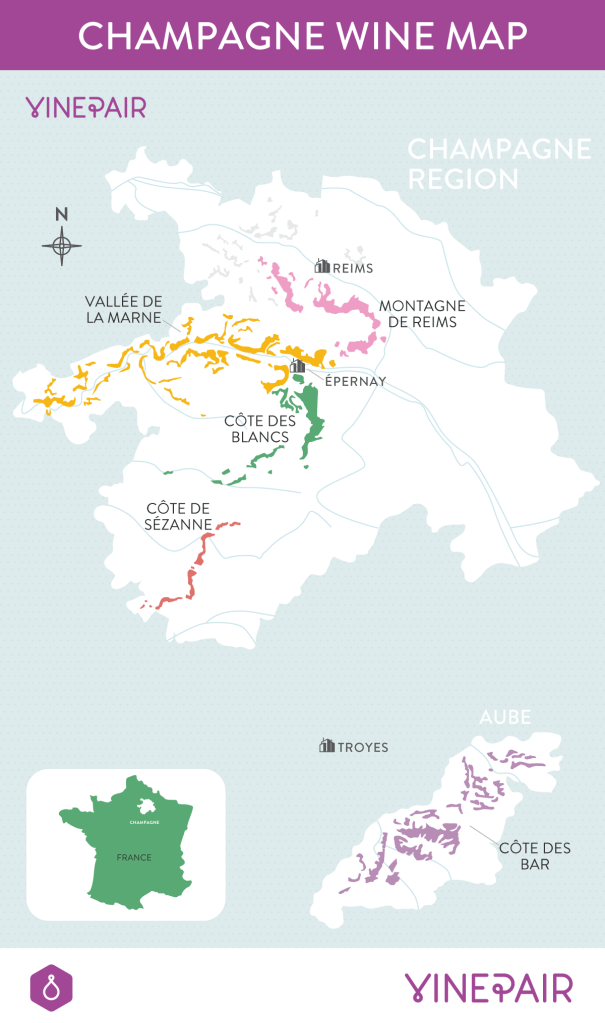
The 34,200 ha (84,500 acres) of vineyards in Champagne are divided into five main zones:
- Montagne de Reims: a plateau between the Marne River and the city of Reims. It is largely planted to Pinot noir but it also shows good plantings of Chardonnay and Meunier.
- Vallée de la Marne: a stretch along the Marne River west of the town of Épernay. This frost prone region is heavily planted by Meunier.
- Côte des Blancs: a ridge running south and southwest from Épernay. As the name suggests, it is famous for its Chardonnay.
- Côte de Sézanne: a region beyond the town of Sézanne, situated southwest of the Côte des Blanc. Similar to its neighbour, it is better known for Chardonnay.
- Côte des Bar: an isolated area to the southeast of Épernay in the Aube department. It is best suitable for Pinot noir production.
Soil
Two particular sub-soils of the region are known as chalk and limestone-rich marl.
These soils allow the vine roots to dig freely and deeply, they also have the ability to retain optimum levels of moisture by allowing the excess water to drain away and keep the soil at a somewhat constant temperature throughout the year.
The Côte des Bar lies on top of a ridge of soil known as Kimmeridgian marl. This is a limestone-rich soil mixed with clay. It is formed by fossilized marine deposits from an ancient sea that formed the Paris Basin. Its characteristics include excellent water retention, heat retention, and heat reflection.
Grape Varieties
Pinot Noir, Pinot Meunier and Chardonnay are the primary grape varieties used to make Champagne.
Pinot Noir – accounts for 38% of planting.
It is the predominant grape variety on the Montagne de Reims and the Côte des Bar where the cool, chalky terrain suits it perfectly.
It adds backbone and body to the blend, producing wines with distinctive meaty and red berries aromas and good structure.
Meunier – accounts for 32% of planting.
This robust grape variety shows better cold-weather resistance than the pinot noir and is particularly well suited to Vallée de la Marne. It is less susceptible to rot-inducing springtime rains and crop-damaging Autumn frosts.
The meunier adds roundness to the blend, with good acidity, producing supple, fruity wines that tend to age more quickly.
Chardonnay – accounts for 30% of plantings.
The chardonnay is the main varietal on the Côte des Blancs and Côte de Sézanne.
It yields delicately creamy and fragrant wines with characteristic notes of flowers, citrus, stone fruits and sometimes minerals. It produces wines that are elegant and built to age.
Champagne Classification
The villages of Champagne have a classification scheme known as the échelle des crus. This system rates each village in Champagne based on the quality of its grapes.
The villages are classified based on score (or échelle, meaning “scale”)
319 crus (on 317 communes):
258 crus (classés à 80-89%)
44 premier crus (classés à 90-99%)
17 grands crus (classés à 100%)
Production
The base wine production process for Champagne is similar to that for other wines. Later it includes an additional and an important stage called as second fermentation in the bottle by the addition of yeast and sugars.
This is the step which provides the carbon dioxide bubbles to the champagne which is responsible for the pop and sparkle.
Méthode Traditionnelle (known as Méthode Champenoise, Méthode Classique)
PRODUCTION OF BASE WINE (Vins Clairs)
The region of Champagne is only permitted for Hand Harvesting of the grapes and whole cluster pressings are done to minimise the time between harvest and juice extraction.
The region of champagne has around 20 strict regulations for pressing grapes after the harvest.
Traditional measurement for the quantity of grapes allowed in the press is known as a marc, which is 4000 kilograms (8,800 pounds). The total amount of juice extraction from a marc is limited to a maximum of 2,550 liters.
1. The first light pressing along with the free run juice is known as cuvée and is around 2050 liters. It is rich in sugars and acids and is generally used for premium category champagne production.
2. The second pressing provides around 50 liters of grape juice which is called ‘taille’. It has good levels of sugar but lower levels of acids and is used for demi-sec or extra dry champagne production.
3. The third pressing is known as rebêche and is used to produce still wine, spirits, vinegar, or local vin de liqueur known as Ratafia de Champagne.
Taille produces intensely aromatic wines – fruitier in youth than those made from the cuvee but are less age-worthy.
BLENDING (Assemblage)
A typical sparkling wine production facility will have wines from different pressings, grape varieties and even vineyards.
More often these wines are mixed together in varying combinations and proportions to create one or more blends or cuvées.
Various forms of Champagne
1. Blanc de Blancs (White from Whites)
2. Blanc de Noirs (White from Blacks)
3. Blanc (Blend of Black and White grapes)
4. Rosé (By adding red wine to white wine, by small short maceration with the skins of red grapes, or making a pink wine via saignée method)
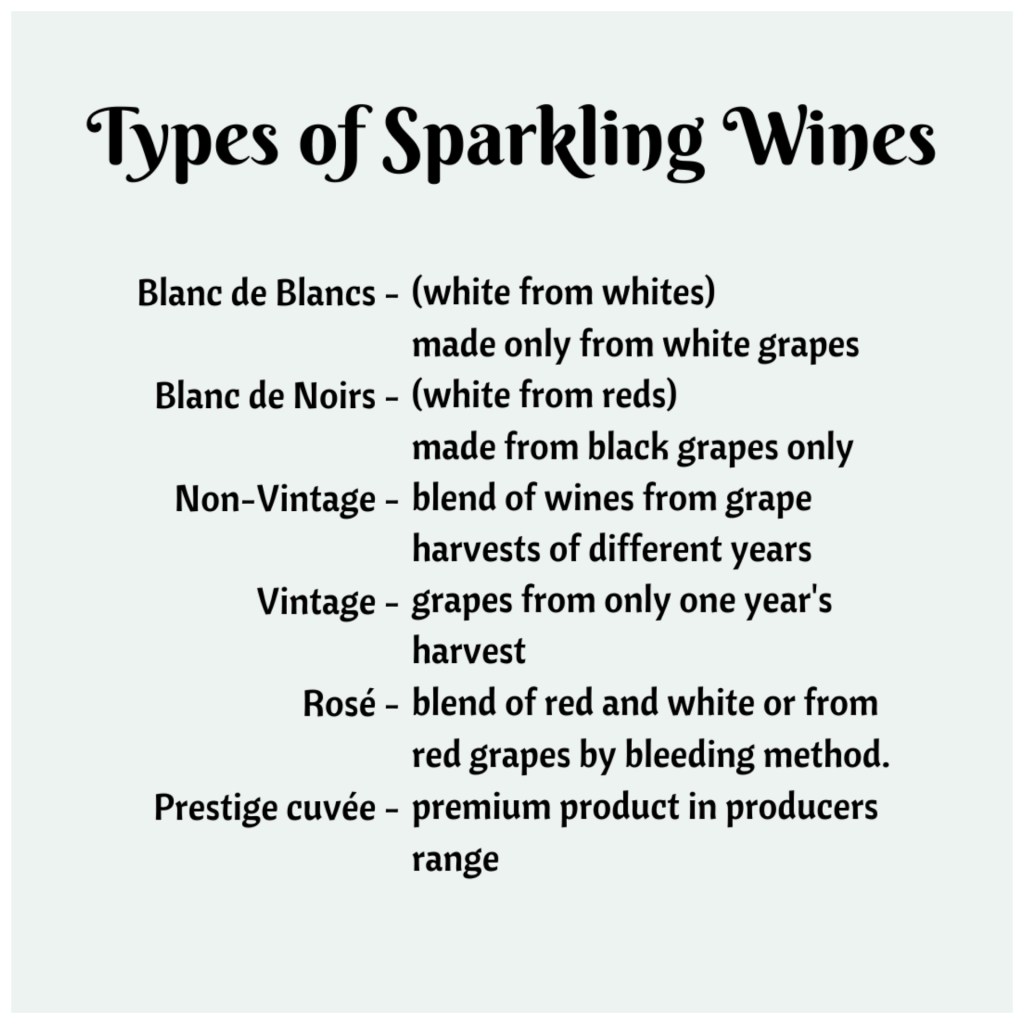
Vintage Champagne (Millesimé in French)- made from a cuvée of base wines from a single vintage year.
Non Vintage – made from a cuvée of base wines from more than one years’ harvest. This is mostly the highest volume category also known as the ‘house style’ due to its consistent flavor profile.
Prestige cuvée are the top-quality wines are also known as tête de cuvée, cuvée spéciale.
This is regarded as the brand’s very best wine, made from the earliest part of the first pressing of the most exceptional grapes and treated with extraordinary care. It is usually also a vintage wine.
Grand Cru Champagnes and Premier Cru Champagnes are those made from the region’s very finest and highest-rated vineyards. (Only Chardonnay and Pinot noir grapes are used for Grand Crus)
Once the base blend or cuvée is ready, it undergoes fining, racking and cold stabilization before going for the next and most important step of sparkling wine production.
SECOND FERMENTATION – PRISE DE MOUSSE
When the time comes to begin the second fermentation process, a mixture of yeast and sugar called the liqueur de tirage is added to the cuvée. The bottles are then sealed, usually with a temporary crown cap.
With sugar available, the yeast cells begin the second fermentation, breaking down the sugar and creating alcohol and carbon dioxide. The extra alcohol raises the level in the wine by a small amount, usually from 10% or 11% to 11% or 12.5% abv.
The carbon dioxide gas builds pressure within the sealed bottle, causing the gas to dissolve into the liquid. This second alcoholic fermentation occurs slowly due to the low temperature in the cellars or caves. The yeast cells also have difficulty multiplying in a wine that already contains 10% to 11% alcohol. The process can easily take a month or even longer.
Liqueur de tirage – 20-24g sugar + yeast + nutrients. 4g of sugar = 1 bar of pressure
LEES AGEING – By the time the sugar has been used up, the pressure in the bottle is typically 5-6 atmospheres. As fermentation continues, the yeast cells use up all the sugar and with increasing alcohol, they die.
The dead yeasts are called lees and decompose to release compounds that create toasty, nutty flavors in the wine by a process known as autolysis.
This is an important flavor component of Traditional Method sparkling wines.
Longer yeast contact = more yeasty flavors.
Prestige and vintage sparkling wines usually are left for an extensive time sur lie, that is, on the yeast lees.
1. All Champagne must spend at least 12 months aging on its lees.
2. Non-vintage Champagnes must mature in bottles for a minimum of 15 months in total before release (i.e. an extra 3 months after the yeast sediment is removed at disgorgement)
Although many producers let their champagne mature for 2 to 3 years.
3. Vintage Champagnes must spend 36 months in a bottle, although most are aged for 4 to 10 years.
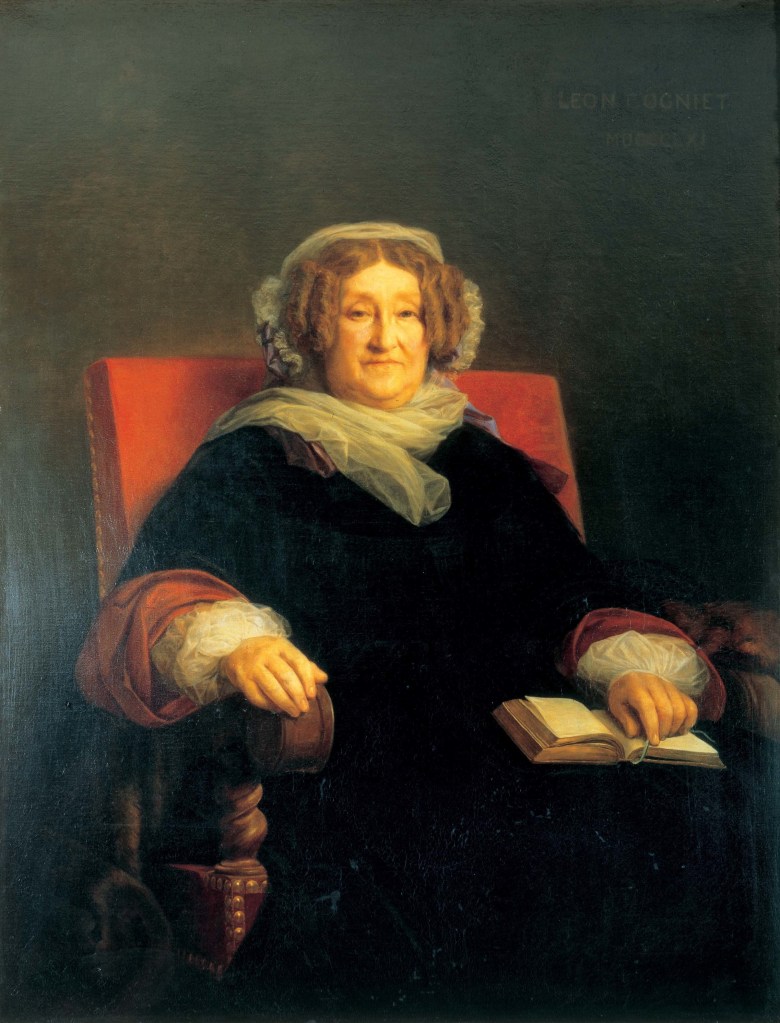
Mme Lily Bollinger invented the RD style (aged minimum 8 years)
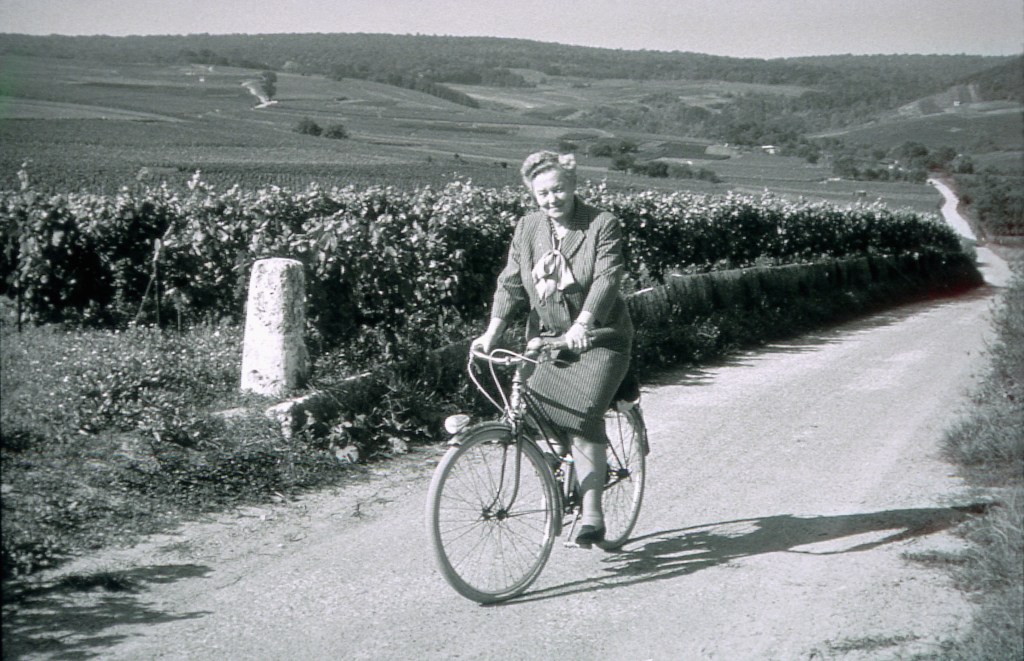
― Lily Bollinger, (1899-1977), Bollinger Champagne
The longer aging time also allows the carbon dioxide to dissolve more thoroughly into the wine, which will ultimately translate into a finer, smaller bubble size in the glass.
REMUAGE/ RIDDLING
The process of bringing lees to the neck of the bottle by turning the bottle upside down is called ‘remuage’.
It can be done-
By a machine called GYROPALETTE which has a capacity of 504 bottles (126 bottles in four rows) and takes around 8 days.
By hand on a riddling rack called a PUPITRE which has a capacity of 60 bottles and takes almost 8 weeks to get the task done.
DÉGORGEMENT/ DISGORGEMENT
Removing yeast from the bottle.
Dégorgement à la glace – the neck of the bottle with all the collected sediment is frozen to -25°C.
The crown cap is removed and the frozen sediment gets ejected by the force within the bottle.
Dégorgement à la volée – old fashioned way as it does not include the step of freezing the bottle neck. (it thus leads to loss of some volume of wine.)
DOSAGE : liqueur d’expédition
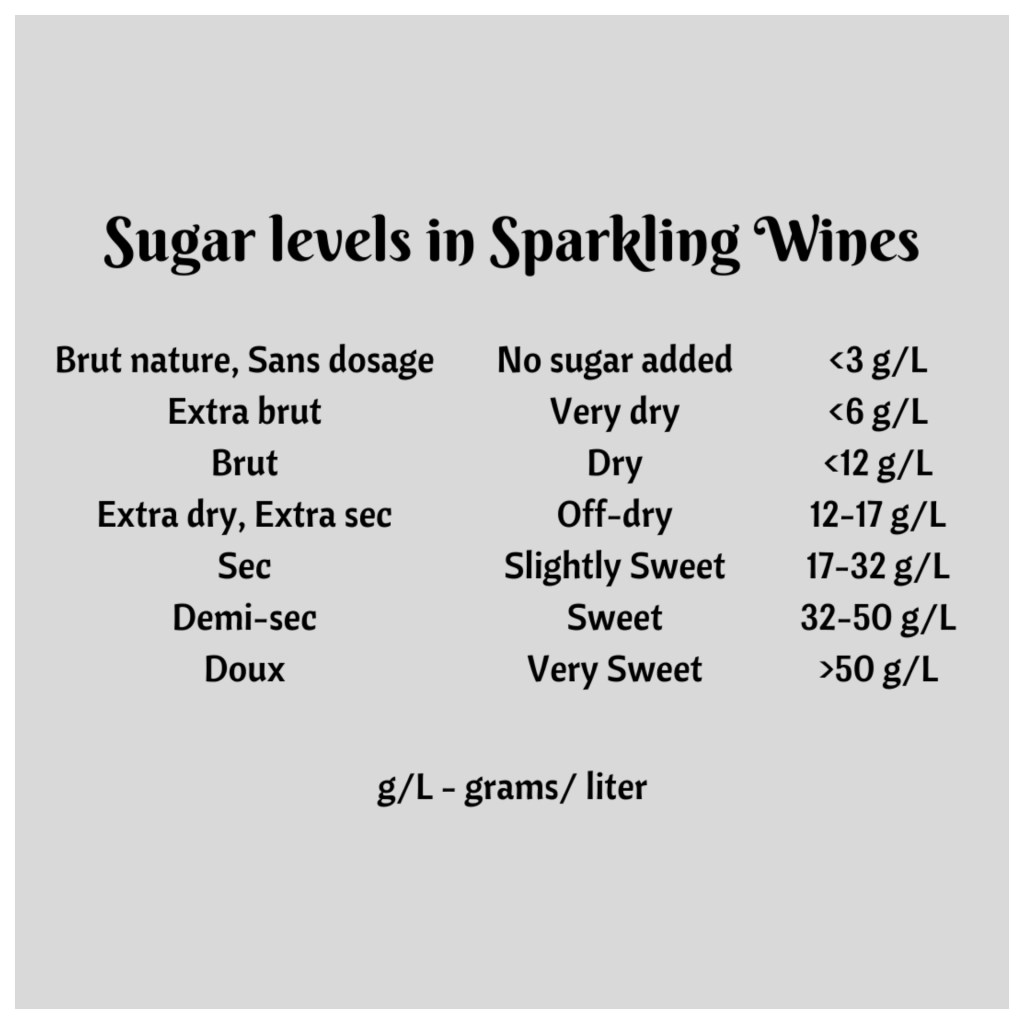
The high acidity of the wine gets amplified in the mouth by the bubbles, so a little sugar comes handy to balance the wine. This is accomplished by adding some sugar to the dosage.
The following champagne styles are achieved by adding different amounts of sugar levels.
CORKING
The bottle is resealed as quickly as possible with a large cork which is specially designed to withstand the 6 atmospheres of pressure pushing against it. The cork is super compressed before insertion so the top part which extends out of the mouth of the bottle bulges giving it a mushroom shape. For more security, the cork is held in place with a wire cage known as ‘muselet’.
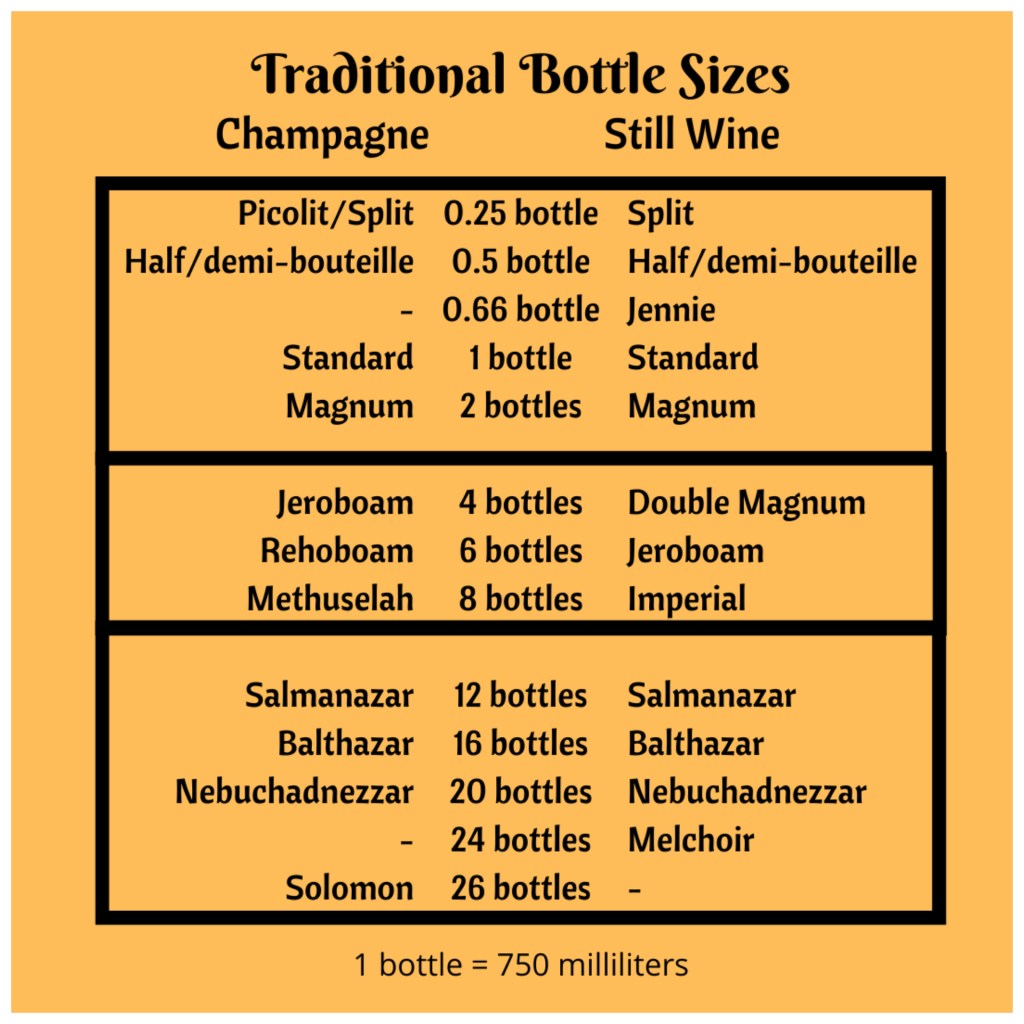
Traditional Champagne Bottle Sizes compared to Still wine bottle sizes.
 The Wine Geek