
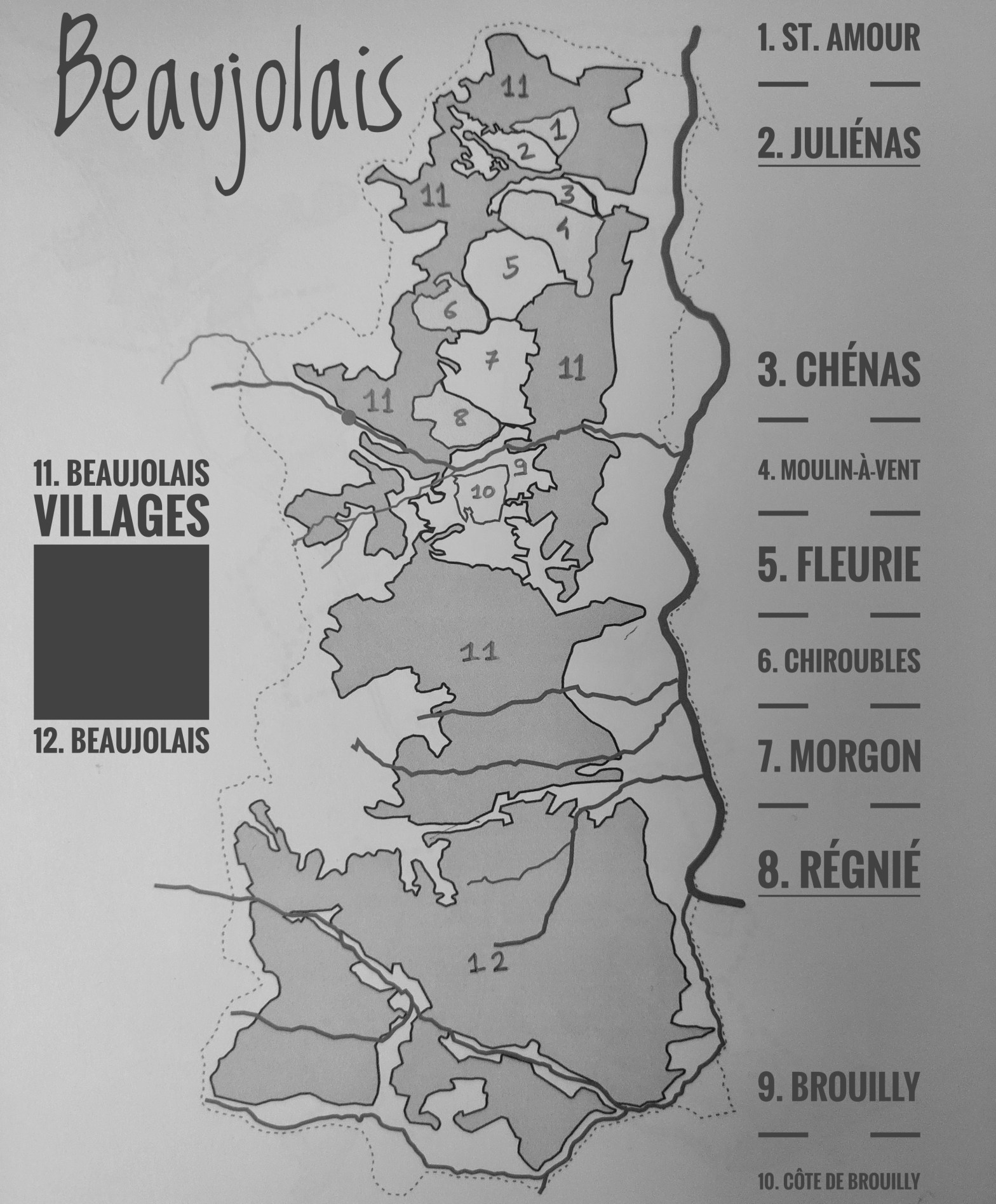
Beaujolais gets its name from the town of ‘beaujeu’
Climate: Semi-continental climate – temperate to cold winters and hot mostly dry summers.
Soil: The soils of Beaujolais are divided into a northern and southern half, with the town of Villefranche serving as a near dividing point.
- Northern part – also known as Haut Beaujolais – includes rolling hills of schist and granite based soils with some limestone. On hillsides, most of the granite and schist is found in the upper slopes with the lower slopes having more stone and clay composition.
- Southern part – also known as the Bas Beaujolais, has flatter terrain with richer, sandstone and clay based soils with some limestone patches. Famous for the land of Golden Stones called as ‘Pierre dorées’
Rivers: 3 main rivers – Rhone, Saone, Beaujolais
Location : Surrounded by the following regions from 4 sides
- North – Saint-Véran, Mâconnaise, Bourgogne
- East – Saone river
- West – Beaujolais mountains
- South – Monts du Lyonnais, Lyon.
Area : Roughly 50,000 acres (20,200 hectares) of grapevines spread across a length of 50 kms.
Grapes : Gamay Noir á Jus Blanc. (Cross of Pinot Noir ╳ Gouais Blanc) Almost 98 %
Chardonnay
Aligote – only allowed until 2024.
Small quantities of Gamay de Bouze, Chaudenay Gamay, Melon de Bourgogne, Pinot Gris (Pinot Beurot) are also present.
Aspect : East to South-East exposition with succession of hills and slopes.
Viticulture : Bush Wine Training.
Winemaking : Semi-Carbonic Maceration
Wine Styles – Red, Rose, White, Red Nouveau and Rose Nouveau.
AOC – Total 12
Two Regional AOCs:
- Beaujolais/Beaujolais Supérieur – September 1937
- Beaujolais Villages – 1950
Ten Communal AOCs – 10 Crus du Beaujolais (from north to south)
- Saint Amour AOC decree: 8 Feb 1946
- Julienas AOC decree: 11 Mar 1938
- Moulin a Vent AOC decree: 11 Sep 1936
- Chenas AOC decree: 11 Sep 1936
- Fleurie AOC decree: 11 Sep 1936
- Chiroubles AOC decree: 11 Sep 1936
- Morgon AOC decree: 11 Sep 1936
- Regnie AOC decree: 8 Dec 1988
- Côte de Brouilly AOC decree: 19 Oct 1938
- Brouilly AOC decree: 19 Oct 1938
AOC Beaujolais / Beaujolais Supérieur
- Can produce Red, Rose, White, and Nouveau wines.
- Covers almost 72 communes
- Soil: Pink Granite, Bluestone, Limestone, Clay.
- Minimum 10% abv for Beaujolais and 10.5% abv for Superieur
- About half of the total Beaujolais wines comes under AOC Beaujolais
- Majority of it comes under Southern Bas Beaujolais.
- Large portion of wines produced are sold Beaujolais Nouveau
- Maximum yield of 60 hl/ha (65 hl/ha for a bumper crop), although the limit is 58 hl/ha to qualify for Superieur designation
Red
- TASTING: Enticing, fruity and crisp.
- NOSE: Concentrated with freshly picked, slightly spicy red fruit
- CULINARY SUGGESTIONS: Brunch, raw veggies, chicken fricassee, andouillette sausage, poultry terrine, braised veal tenderloins, sugar tarts and raspberry tarts.
- COLOUR: Crimson red
- SERVING TEMPERATURE: 12-14°C
- PALATE: Lively, both fresh and round, it brings to mind red berries with delicate tannins. The Beaujolais Pierres Dorées are more structured
Rosé
- TASTING: refreshing, expressive and accessible to all
- NOSE: delicate aroma of flowers and red fruit
- COLOUR: glistening, pale with salmon-pink highlights
- SERVING TEMPERATURE: 5-8°C
- PALATE: supple, fruity and thirst-quenching
AOC Beaujolais Villages
- Red, Rose and Whites
- Produced in around 38 communes/villages in the Northern Haut Beaujolais.Has the following soil: Gneiss, Band of blue stones, Sandstone, Shale, Granite.
- Accounts for almost 25% of all wines produced in Beaujolais.
- Very small amount of Nouveau wines (Not very common)
- Producers can affix the name of the villages of Beaujolais if the grapes come from a single vineyard or commune.
- Maximum permitted yield is 58 hl/ha.
- Meant to be consumed young within 2 years of their harvest.
White
- NOSE: Fruity, citrus, mineral
- CULINARY SUGGESTIONS: Seafood, spice-crusted salmon, cod burger, scallops in cream sauce, sweetbreads, pike in white butter sauce, roasted pork with apples, sole meunière
- COLOUR: Intense, pale gol
- SERVING TEMPERATURE: 7-10°
- PALATE: Mouth-filling, balanced
Red
- TASTING: Supple, delicate, rich and expressive red fruit fragrance
- NOSE: Black and red fruit
- CULINARY SUGGESTIONS: Grilled rib of beef, roasted veal with mushrooms, skirt steak with shallots, pork chops in tomato sauce, beef bourguignon, chicken liver loaf, cream of lentil soup, rabbit terrine, grenadine of veal, strawberry and peach soup with black pepper, praline tart and wine-poached pear
- COLOUR: Garnet red, ripe cherry
- SERVING TEMPERATURE: 12-14°C
- PALATE: Powerful, structured and harmonious
Rosé
- TASTING: Produced in small quantities and in high demand, its forwardness is what’s appealing.
- NOSE: Black and red fruit
- CULINARY SUGGESTIONS: Parsley ham, chicken sautéed with bell peppers, grilled aubergines with tomato and parmesan, oven-baked mackerel, Provençal-style roast chicken breast, pasta salad with bell pepper and tuna, fresh fruit salad: COLOUR: Pale pink with salmon-pink highlights
- SERVING TEMPERATURE: 5-8°C
- PALATE: Mouth-filling and crisp, offering roundness and refreshing smoothness
AOC Crus Beaujolais
- The 10 crus villages of Beaujolais produce the highest quality wines.
- Seven crus relate to actual villages – namely Saint-Amour, Juliénas, Chénas, Fleurie, Chiroubles, Morgon, Régnié.
- Cru of Moulin-a-Vent is named after a local windmill.
- Brouilly and Cote de Brouilly refer to vineyard areas around Mont Brouilly.
- Vineyards in the Cru villages are not allowed to produce Nouveau wines.
- Maximum yield is limited to 48 hl/ha.
 The Wine Geek